Why Technically Correct Distributed Systems Still Feel Broken to Users.
Correctness in distributed systems is not just about data, retries, and uptime. It is also about how the system behaves from the user’s point of view.
Introduction
There is a certain kind of production issue that is easy to miss if you only look at service dashboards.
Nothing is completely down. Error rates are low. Retries are happening as expected. Messages are moving through the system. Given enough time, the data even becomes consistent. From an infrastructure perspective, the architecture appears to be doing its job.
And yet users still feel that something is broken.
They raise support tickets. They retry actions. They lose confidence in the product. In some cases, they see a payment succeed before an order is confirmed. In others, they receive duplicate notifications, stale status updates, or workflows that appear stuck even though the backend is still making progress.
This is the part of distributed systems that I think is often under-discussed.
We spend a lot of time talking about availability, latency, retries, scaling, and eventual consistency. All of those things matter. But there is another layer that becomes just as important in real production systems: how the system behaves from the user’s point of view while all of that complexity is unfolding underneath.
A system can be technically correct and still feel unreliable.
That gap between internal correctness and external trust is what this article is about.
The Core Mismatch
At a low level, distributed systems are built around partial truth.
Each service knows only part of the workflow. State is spread across multiple boundaries. Some updates are synchronous, others are delayed, and many outcomes are only eventually visible after retries, event propagation, or background reconciliation. From an engineering point of view, this is completely normal. In many cases, it is the right trade-off for scale, fault tolerance, and loose coupling.
But users do not experience systems that way.
They do not think in terms of asynchronous processing, eventual consistency, or message delivery semantics. They see a single product, a single action, and a single expectation. They click a button, submit a request, or complete a payment, and then ask a very simple question:
Did the thing I asked for actually happen?
That is where the mismatch begins.
The system sees valid intermediate states. The user sees uncertainty.
The system sees progress distributed across services. The user sees conflicting signals.
The system sees retries, compensation, and eventual convergence. The user sees delay, inconsistency, or silence.
And that difference matters more than many teams realize. In production systems, trust is not built only on whether the backend eventually reaches the right state. It is built on whether the system remains understandable while it is getting there.
That is why a workflow can be technically healthy and still feel unreliable from the outside.
A Realistic Example
Consider a fairly common order placement workflow.
A user places an order through a web application. The API accepts the request and immediately returns a success response to avoid keeping the user waiting. The order service stores the order in a pending state and publishes an event so the rest of the workflow can continue asynchronously.
From there, multiple things happen in parallel.
A payment service processes the charge. An inventory service tries to reserve stock. A notification service waits for downstream updates so it can send confirmation to the user. Depending on the architecture, there may also be fraud checks, shipment preparation, loyalty updates, or analytics events happening in the background.
On paper, this design is perfectly reasonable. It is scalable, loosely coupled, and better suited for real production traffic than one giant synchronous transaction spanning every dependency.
But now look at it from the user’s side.
The payment may succeed quickly, so the bank shows a completed charge almost immediately. Inventory reservation may take longer because a dependent service is under load. The notification may be delayed because a consumer is retrying after a timeout. For a few minutes, the user sees a charged card, a pending order, and no confirmation message.
From an internal systems perspective, the workflow may still be healthy. Events are flowing. Retries are working. No data has been permanently lost.
But from the outside, the system already feels unreliable.
That is the kind of gap this article is really about.
The Workflow Looks Fine On Paper
At a design review level, this kind of workflow usually looks completely reasonable.
The request is accepted quickly. Long-running work is pushed into asynchronous processing. Independent concerns like payment, inventory, and notifications are separated into their own services. Failures can be retried without blocking the initial request. From an architectural point of view, this is often the right direction.
But the more important question is not whether the diagram looks clean.
It is whether the user-visible experience remains coherent while the workflow is unfolding across those independent steps.
This is the point where distributed architecture stops being just a backend concern. The moment state changes are revealed to a user, architectural timing becomes product behavior.
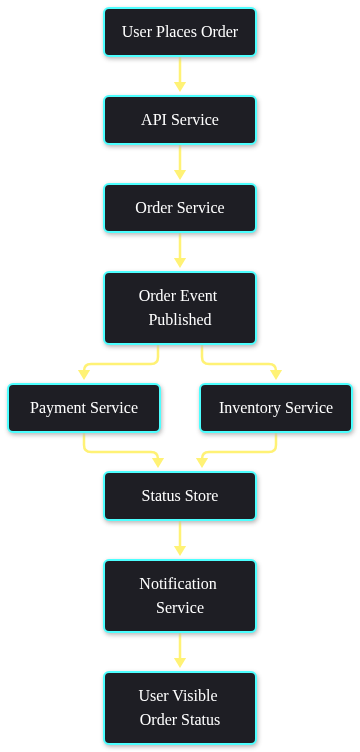
What this diagram hides, unless we think about it carefully, is time.
The API may return quickly. Payment may complete first. Inventory may lag. Notifications may be delayed. The status store may briefly reflect only part of the truth. By the time the user checks the application, they may be looking at a system that is still converging internally but already broadcasting mixed signals externally.
That is why a technically healthy workflow can still feel broken.
The architecture is not failing in the traditional sense. It is failing to preserve a trustworthy interpretation of progress.
Where Systems Start Feeling Broken
Once a system is split across services, queues, and asynchronous workflows, the real challenge is no longer just whether it works. The harder question is whether it behaves in a way that still makes sense to the people using it.
There are a few patterns that repeatedly make technically healthy systems feel unreliable.
One of the most common issues is ambiguous status design. States like "processing," "in progress," or "submitted" may mean something to the backend team, but they often mean very little to the user. They indicate that some work has started, but they do not explain what has completed, what is still pending, or whether the request is actually safe.
Another recurring problem is technical completion without business completion. A service may consider its job done because it stored a record, emitted an event, or acknowledged a message. But from a user’s perspective, none of those things matter unless the actual business outcome has happened. This is where internal success and external success begin to diverge.
Inconsistent timing across visible signals creates another layer of confusion. Users do not interpret system events independently. They combine them into one mental model. If payment is reflected immediately but the order still appears pending, or if a notification arrives before the interface is updated, the system starts to look contradictory even when each component is behaving correctly on its own.
Retries can also leak into the user experience in surprisingly messy ways. Retries are essential in distributed systems, but if side effects are not carefully controlled, users may see duplicate emails, repeated notifications, or multiple status transitions. At that point, the issue is no longer just technical resilience. It becomes behavioral instability.
Then there is the observability gap. Most teams monitor latency, throughput, error rates, and resource usage. Those metrics are important, but they do not fully capture whether the user journey feels coherent from start to finish. This is where user-centric telemetry, workflow-level tracing, and end-to-end state visibility become much more valuable than service health alone. A system can look healthy from the inside while still creating long windows of uncertainty for the people using it.
These issues rarely look dramatic in logs or dashboards, but they are often the exact reasons users stop trusting a platform. That is why behavioral correctness matters just as much as technical correctness in modern distributed systems.
Designing for Trust, Not Just Technical Correctness
A useful shift in distributed system design is to stop thinking only about whether the system is technically correct and start thinking about whether it preserves trust while that correctness is still unfolding.
That sounds subtle, but it changes the way we make architectural decisions.
A technically correct system eventually reaches the right state. A trustworthy system helps users understand what is happening while the system is getting there. Those are not always the same thing.
This means status design becomes much more important. A vague label like "processing" may be convenient internally, but it often hides too much uncertainty from the user. In contrast, a more honest status model can communicate whether the request has been accepted, whether downstream steps are still in progress, and whether any user action is actually required.
It also means that externally visible state should be treated as a product decision, not just a backend byproduct. If different services complete at different times, the system should not expose those timing differences in a way that creates contradiction. The goal is not to reveal every internal transition. The goal is to present a stable and truthful interpretation of progress.
This is where many systems go wrong. They optimize for decomposition, retries, and asynchronous throughput, but they do not spend enough time defining what the user should see while all of that complexity is playing out underneath. As a result, the system may be operationally healthy while still feeling unpredictable.
Designing for trust means asking better questions early. What will the user believe is happening at this stage? Which transitions are safe to expose externally? Where can internal delays create visible confusion? Are we being precise about uncertainty, or are we masking it behind generic labels?
These are not just interface questions. They are architectural questions, because the moment internal state becomes user-visible, timing, sequencing, and failure handling become part of the product experience.
In other words, modern distributed systems should not be judged only by whether they converge. They should also be judged by whether they remain understandable while they converge.
What This Changes In Real System Design
Once you start thinking in terms of trust-preserving behavior, a few design choices become much more deliberate.
Separate internal processing from external state. Internally, a workflow may go through many transitions across multiple services, retries, and compensating paths. But that does not mean every internal transition should be exposed directly to the user. External states should be stable, meaningful, and intentionally designed around what the user actually needs to know.
Define precise success semantics. In many systems, an API returns success simply because it accepted a request or stored a record. That may be technically true, but it can still be misleading if the user interprets it as full completion. A better approach is to make the contract explicit. Accepted is not the same as completed. Processing is not the same as confirmed. The semantics of each state should reflect the real business outcome, not just the current implementation step.
Treat notifications as part of the correctness model. Notifications are often seen as an add-on concern, but in distributed systems they shape user trust in a big way. A delayed, duplicated, or poorly timed message can create more confusion than a temporary backend delay. That means notifications need the same design discipline as APIs and workflow state models.
Expand observability beyond service health. It is not enough to know that queues are draining and services are responding within acceptable latency. We also need to know how long users remain in uncertain states, how often they see contradictory signals, and where workflows appear stalled even though the system is still making progress internally.
Taken together, these choices change the way we think about architecture. We are no longer designing only for eventual correctness. We are designing for a system that remains coherent, truthful, and trustworthy while that correctness is still in motion.
Conclusion
Modern distributed systems are very good at decomposing work across services, queues, and asynchronous boundaries. That flexibility gives us scale, resilience, and operational independence. But it also creates a new responsibility. We are no longer designing only for execution. We are also designing for interpretation.
From the system’s point of view, partial progress is normal. Retries are normal. Delayed consistency is normal. But from the user’s point of view, what matters is much simpler: did the system behave in a way that felt coherent, truthful, and dependable while all of that complexity was playing out underneath?
That is why I think one of the most important design questions in modern architecture is no longer just whether the system is technically correct. It is whether the system preserves trust while correctness is still unfolding.
A system that eventually converges is important. A system that remains understandable while it converges is even better.
And in many real production environments, that difference is what users experience as reliability.
Comments
Join the discussionNo comments yet. Be the first to comment.