Vert.x Worker Threads vs Event Loop Threads: What Actually Runs Where?
A practical guide to understanding execution flow in Vert.x, avoiding blocked event loops, and choosing the right threading model for real-world Java services.
Introduction
If you come from a traditional Java backend background, Vert.x feels a little unusual at first. In a Spring-style request-per-thread model, the mental model is simple: one incoming request gets a thread, that thread does the work, and eventually the response goes back.
Vert.x changes that model completely. It is built around event loops, asynchronous handlers, and the idea that a very small number of threads can handle a very large number of requests efficiently.
That sounds great in theory, but this is also where confusion starts. A lot of developers know that Vert.x is “non-blocking,” but they do not fully understand what actually runs on the event loop, what should be moved to worker threads, and why a single accidental blocking call can damage latency for many users at once.
That confusion is exactly where production issues begin.
This article is about clearing that up in a practical way. Not with abstract reactive buzzwords, but by answering a very concrete question: in Vert.x, what actually runs where?
By the end, the goal is to make the execution model feel intuitive. Once that clicks, it becomes much easier to design handlers correctly, avoid blocking mistakes, and choose between event loop threads, worker threads, and newer options like virtual threads.
Why This Topic Matters
This topic matters because thread usage in Vert.x is not just an implementation detail. It directly affects throughput, latency, scalability, and failure behavior.
If you misunderstand the threading model, the application may still compile, tests may still pass, and the service may even look fine under light traffic. But once concurrency increases, the wrong kind of work on the wrong thread starts creating queueing, slow responses, timeout chains, and noisy downstream failures.
The important thing to understand is that Vert.x gets its efficiency from doing less thread switching and keeping the event loop free to keep processing events. So when people say “don’t block the event loop,” that is not just a style preference.
It is the core performance rule of the platform. Break that rule, and the system stops behaving like a highly concurrent event-driven runtime.
In real systems, the confusion usually comes from perfectly normal backend work: reading from a database, calling another service, parsing a big file, generating a report, or doing encryption or CPU-heavy transformation. Those tasks are common, but they do not all belong on the same thread type.
The real skill in Vert.x is not just writing handlers. It is placing work in the correct execution context.
The Core Mental Model
The easiest way to think about Vert.x is this: event loop threads are meant to keep the system moving, not to sit and wait. Their job is to receive events, dispatch handlers, coordinate asynchronous operations, and move quickly to the next piece of work.
They are optimized for responsiveness, not for long-running or blocking tasks.
A blocking operation is any operation that makes the thread wait instead of continuing. That includes obvious things like Thread.sleep, synchronous file reads, traditional JDBC calls, long locks, or waiting for a remote service synchronously.
If that blocking happens on an event loop thread, that thread cannot process other events during that time.
Worker threads exist for the opposite kind of work. They are for tasks that may block or take longer.
If you know a task cannot stay lightweight and non-blocking, it should be pushed off the event loop and onto a worker thread or a different execution model.
So the short version is : Event loop threads handle fast, non-blocking coordination. Worker threads handle blocking or longer-running work.
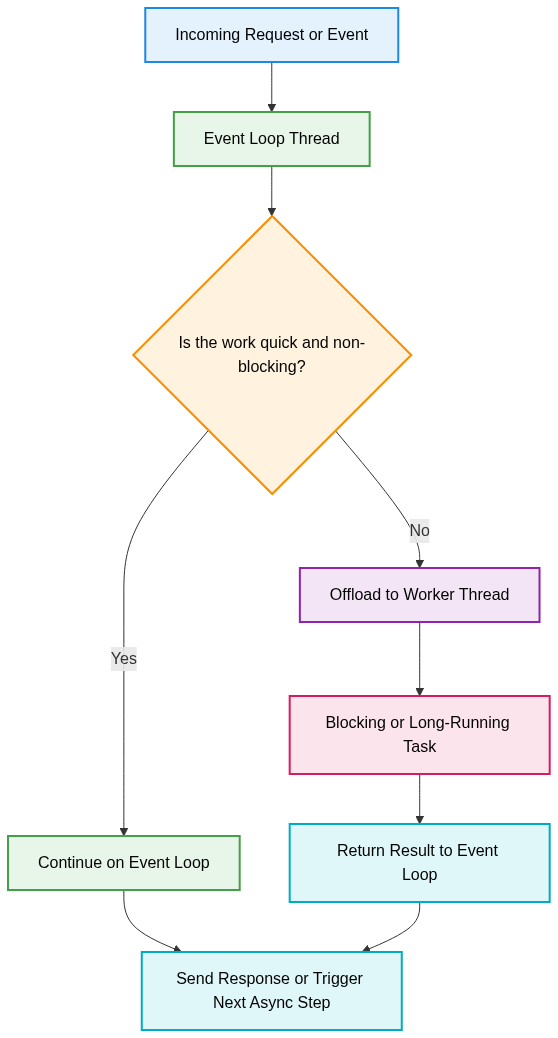
That is the main idea, but the interesting part is understanding how that plays out in actual request flow.
What Runs on the Event Loop
In Vert.x, most handler-based logic starts on an event loop thread. That includes HTTP request handlers, route handlers, WebSocket callbacks, timer callbacks, and many asynchronous completion handlers.
These are typically lightweight coordination points. They receive input, validate it, trigger asynchronous operations, transform results, and produce a response.
This is exactly why event loop code should stay small and fast. A good event loop handler feels almost like orchestration code.
import io.vertx.core.AbstractVerticle;
import io.vertx.core.Promise;
import io.vertx.ext.web.Router;

public class EventLoopExampleVerticle extends AbstractVerticle {

    @Override
    public void start(Promise<Void> startPromise) {
        Router router = Router.router(vertx);

        router.get("/hello").handler(ctx -> {
            String name = ctx.request().getParam("name");
            if (name == null || name.isBlank()) {
                name = "world";
            }

            String message = "Hello, " + name;
            ctx.response()
               .putHeader("content-type", "text/plain")
               .end(message);
        });

        vertx.createHttpServer()
             .requestHandler(router)
             .listen(8080)
             .onSuccess(server -> startPromise.complete())
             .onFailure(startPromise::fail);
    }
}
Why this example works
This is good event loop code because it does very little work. It reads an input, performs a tiny in-memory operation, and sends a response. Nothing blocks. Nothing waits.
It reads the request, maybe checks headers or parameters, calls an async client, wires together callbacks or futures, and returns quickly. It is not the place for a slow database driver, a heavy report generation routine, or a large CPU-bound transformation.
One good way to sanity check event loop logic is to ask: if 10,000 connections hit this endpoint, would I be comfortable having this exact code run on a very small set of threads? If the answer is no, the work probably does not belong entirely on the event loop.
What Should Not Run on the Event Loop
This is where most mistakes happen. Developers often start with a clean asynchronous handler, then slowly add “just one more thing” into it: maybe a blocking JDBC query, maybe a call to a legacy SDK, maybe some PDF generation, maybe a file read, maybe an expensive encryption step.
Each one looks harmless in isolation. But once one of those operations blocks an event loop thread, every other request sharing that thread starts paying the price.
The key problem is multiplication of impact. In a thread-per-request model, a slow request usually harms that request.
In an event loop model, a slow blocking operation can harm many requests because the event loop is shared. That is why blocked event loops are so dangerous under concurrency.
Common examples of work that should not stay on the event loop: Synchronous database access through blocking drivers. Reading or writing large files using blocking APIs.
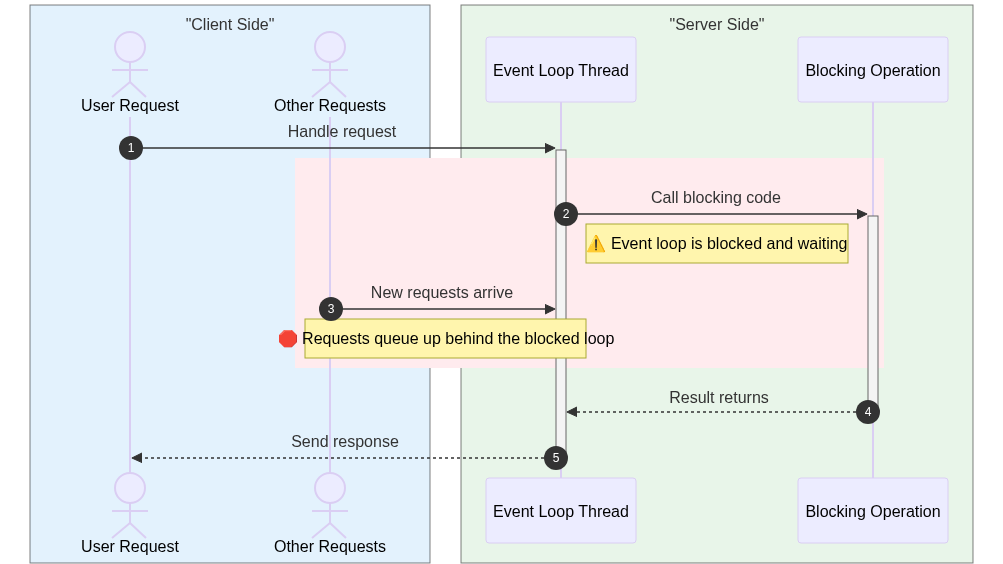
Calling legacy SOAP or REST clients synchronously. CPU-heavy processing such as compression, image transformation, or big JSON/XML parsing.Anything that waits on locks, sleeps, or external responses.
When to Use Worker Threads
Worker threads are the safe place for operations that may block or take a noticeable amount of time. In Vert.x, if you need to integrate with blocking libraries or do heavier work that should not run on the event loop, you offload that work.
The event loop remains the coordinator, and the worker pool executes the task.
This is a very practical compromise because not every real system is fully non-blocking end to end. A lot of enterprise systems still use blocking clients, old libraries, JDBC drivers, document processing libraries, and batch-style computation.
Worker threads let you adopt Vert.x without pretending your entire world is purely reactive.
That said, worker threads are not an excuse to dump everything there. If you push too much work into workers without thinking about pool sizing, backpressure, or request latency, you can simply move the bottleneck from the event loop to the worker pool.
So the right mindset is not “workers fix everything.” It is “workers isolate blocking work so the event loop stays healthy.”
import io.vertx.core.AbstractVerticle;
import io.vertx.core.Promise;
import io.vertx.ext.web.Router;

public class WorkerThreadExampleVerticle extends AbstractVerticle {

    @Override
    public void start(Promise<Void> startPromise) {
        Router router = Router.router(vertx);

        router.get("/report").handler(ctx -> {
            vertx.executeBlocking(promise -> {
                try {
                    Thread.sleep(2000);
                    String report = "Generated report data";
                    promise.complete(report);
                } catch (Exception ex) {
                    promise.fail(ex);
                }
            }, result -> {
                if (result.succeeded()) {
                    ctx.response()
                       .putHeader("content-type", "text/plain")
                       .end((String) result.result());
                } else {
                    ctx.response()
                       .setStatusCode(500)
                       .end("Failed to generate report");
                }
            });
        });

        vertx.createHttpServer()
             .requestHandler(router)
             .listen(8080)
             .onSuccess(server -> startPromise.complete())
             .onFailure(startPromise::fail);
    }
}
Why this example matters ?
The report generation is simulated with Thread.sleep, which represents blocking or long-running work. That kind of work would be dangerous on the event loop, so it is isolated through executeBlocking.
A Real-World Request Flow
Let’s take a realistic example. Suppose a client hits an endpoint to fetch account summary data in a banking service.
The request lands on a Vert.x HTTP route handler, which starts on the event loop. The handler validates the account ID, checks a token, and prepares the next step. So far, that is lightweight and appropriate for the event loop.
Now imagine the service must call a legacy account system using a blocking client library. That work should not remain on the event loop.
The handler offloads the legacy call to a worker thread. Once the result comes back, control returns to the Vert.x pipeline, and the response is built and sent.
That flow is typical of enterprise modernization projects. Not everything is reactive.
Not everything is non-blocking. The real architectural value comes from keeping coordination logic fast and isolating slow dependencies correctly.
This flow is common in enterprise modernization projects. New services may use event-driven or async patterns, but they still need to integrate with legacy systems that were never designed for non-blocking execution.
Worker isolation becomes an important part of that migration strategy.

Worker Verticles vs Standard Verticles
Vert.x also gives you the concept of verticles, which are deployment units. Standard verticles are typically associated with event loop execution for normal non-blocking logic.
Worker verticles are intended for blocking operations. This is useful when the role of the component itself is blocking by nature, rather than just one occasional method.
The distinction matters because sometimes the question is not “should I offload one function?” but “should this entire component be deployed as a worker-style unit?” For example, if a verticle’s responsibility is document generation, batch ingestion, or integration with a blocking library, a worker verticle can make the intent explicit and keep the architecture cleaner.
The practical takeaway is : Use standard verticles for reactive, event-driven coordination. Use worker verticles when the component is mostly blocking in nature.
Use executeBlocking when only a specific section of work needs to be offloaded.
Where Virtual Threads Fit
This is what makes the blog more current and more unique. With newer Java versions, virtual threads introduce another option.
They make blocking-style code cheaper in terms of thread management. That can be very attractive for teams that want simpler code but still need good concurrency.
In Vert.x, virtual threads do not remove the need to understand the event loop. They do not magically make blocking on the event loop safe.
That is the important nuance. The event loop still has the same responsibility: keep moving, stay responsive, do not get pinned down by slow tasks.Virtual threads are more about how blocking work can be handled more efficiently when you intentionally choose that model.
So the right framing is not “virtual threads replace Vert.x thinking.” It is “virtual threads expand the choices for handling certain workloads.” They can reduce complexity in some scenarios, especially for codebases full of sequential blocking logic, but they do not erase the architectural difference between coordination threads and blocking work execution.
import java.util.concurrent.Callable;
import java.util.concurrent.ExecutionException;
import java.util.concurrent.ExecutorService;
import java.util.concurrent.Executors;
import java.util.concurrent.Future;

public class VirtualThreadDemo {

    public static void main(String[] args)
            throws InterruptedException, ExecutionException {

        try (ExecutorService executor = Executors.newVirtualThreadPerTaskExecutor()) {

            Callable<String> paymentTask = () -> {
                Thread.sleep(1200);
                return "payment-service-ok";
            };

            Callable<String> customerTask = () -> {
                Thread.sleep(800);
                return "customer-service-ok";
            };

            Callable<String> ledgerTask = () -> {
                Thread.sleep(1000);
                return "ledger-service-ok";
            };

            Future<String> paymentFuture = executor.submit(paymentTask);
            Future<String> customerFuture = executor.submit(customerTask);
            Future<String> ledgerFuture = executor.submit(ledgerTask);

            String paymentResult = paymentFuture.get();
            String customerResult = customerFuture.get();
            String ledgerResult = ledgerFuture.get();

            System.out.println(paymentResult);
            System.out.println(customerResult);
            System.out.println(ledgerResult);
        }
    }
}
Practical Rules of Thumb
If the code is quick, non-blocking, and mostly coordinating async steps, it belongs on the event loop.
If the code waits on something external using a blocking API, it should move to a worker thread or another appropriate execution model.
If the code is CPU-heavy and long-running, be careful. Even if it is not technically “blocking” on I/O, it can still monopolize a thread and hurt responsiveness.
In that case, isolate it from the event loop.
If you are unsure, think in terms of shared damage. Ask yourself: if this exact piece of work stalls for two seconds, how many other requests get hurt?
If the answer is “many,” then it probably should not stay on the event loop.
Common Mistakes to Call Out
One common mistake is assuming that “small blocking calls” are harmless. Under low traffic, they often are. Under real concurrency, they become queueing points.
Another mistake is treating worker threads as an infinite safety net. They are still a bounded resource.
If every request is offloaded to workers and each worker blocks for too long, the service can still become slow or unstable.
A third mistake is mixing the concepts of asynchronous and non-blocking. Code can look asynchronous in structure and still hide blocking calls internally.
That is why understanding the actual runtime behavior matters more than just the API style.
A final mistake is skipping observability. If you are using Vert.x in production, you want metrics and logs that help you detect blocked event loops, worker saturation, request latency, and timeout growth.
Otherwise, the threading model remains theoretical until something breaks.
Conclusion
The most useful way to understand Vert.x is not to memorize APIs but to internalize one execution rule: event loop threads should stay free to keep the application moving. Once that idea becomes natural, the rest starts making sense.
HTTP handlers, timers, callbacks, and async coordination belong on the event loop when they stay lightweight. Blocking calls, heavy operations, and legacy integrations belong somewhere else, usually worker threads or another explicitly chosen execution path.
That is the real difference between just using Vert.x and using it well. Good Vert.x design is really about execution placement. What runs where is not a low-level detail. It is the design itself.